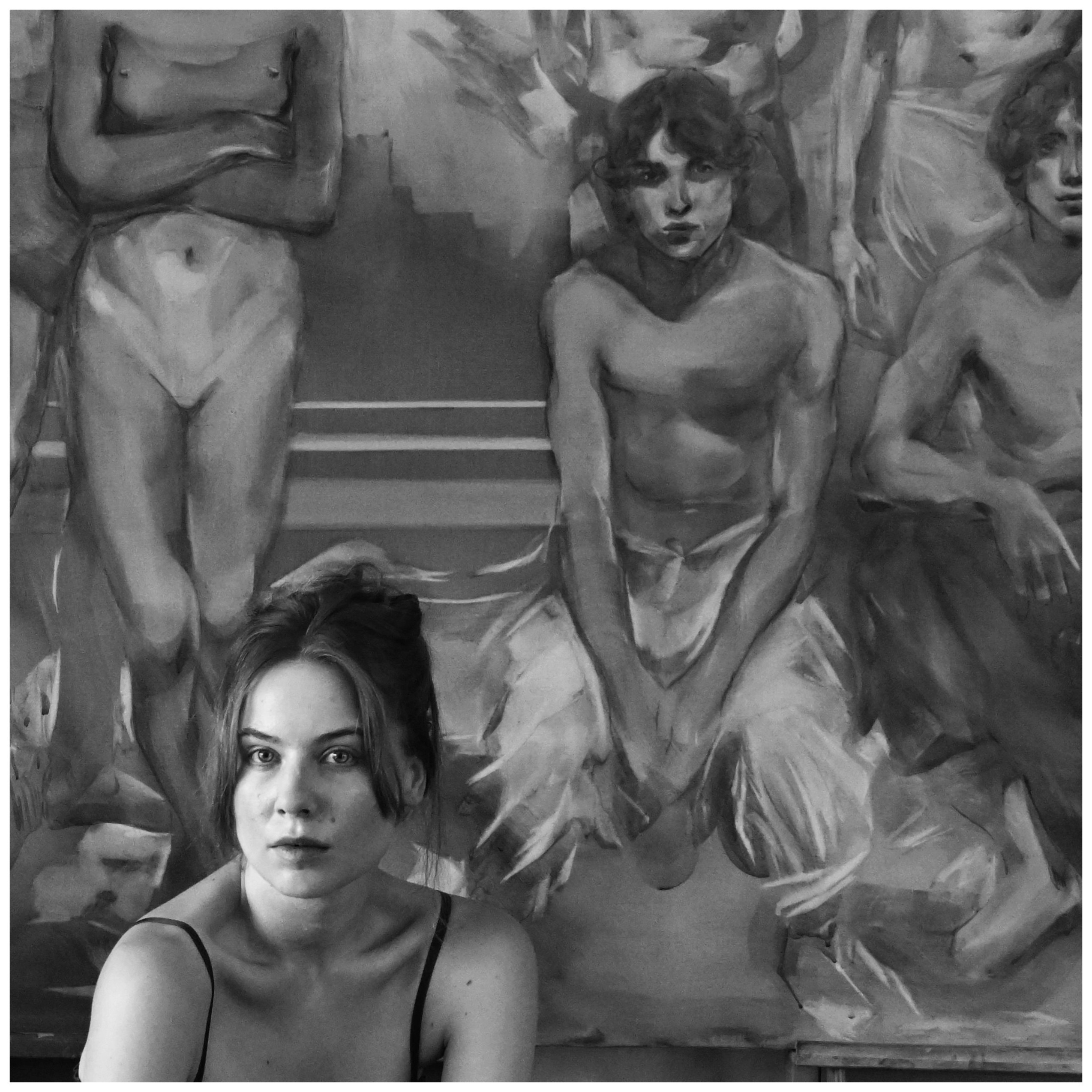
Zuzy Praus is a Czech painter based in Vienna.
She works primarily with egg tempera on large-scale figurative paintings.
Her process is slow and deliberate. Egg tempera allows little correction — each layer remains visible. The painting grows through accumulation, gesture by gesture.
Her figures move between strength and vulnerability. Bodies become structures, landscapes, and quiet symbols. The work draws from journals, memory, and observation.
Alongside monumental canvases, she creates smaller, more intimate studies that often guide the larger compositions.
Praus studied within the lineage of Ulrich Gansert and Helmut Ditsch and works directly in this master–student tradition. She has also collaborated on artistic projects, including the film Helmut – Das Eis und die vergängliche Ewigkeit.
She lives and works in Vienna.
What this exhibition explores
The Shape of Knowledge examines how images preserved in old books—engravings, diagrams, botanical drawings, astronomical charts, early photographs—gave form to ideas long before modern visualization tools existed.
The exhibition explores the ways in which people once interpreted nature, science, society, and the cosmos through images, revealing how knowledge was shaped, structured, and communicated visually.
Why this exhibition was conceived
The exhibition begins with a simple question: how did earlier generations visualize what they sought to understand?
Many of these images were created not as art objects but as instruments of explanation—yet, when viewed today, they exhibit an aesthetic precision and conceptual ambition that far exceed their original purpose.
The Shape of Knowledge invites viewers to reconsider these works not just as historical artifacts but as evidence of a long-standing human impulse: to give shape to the unknown through observation, imagination, and visual form.
The perspective that shapes this exhibition
Rather than presenting these materials strictly through scientific accuracy or historical chronology, The Shape of Knowledge brings together images from disparate fields—botany, astronomy, geology, sociology—through a shared perspective: the visual shaping of understanding.
The exhibition highlights how each image interprets reality in its own way, constructing meaning through line, structure, scale, and symbol.
Through this lens, the works collectively demonstrate how visual representation has long served as a bridge between the seen and the unseen, the known and the not-yet-understood.